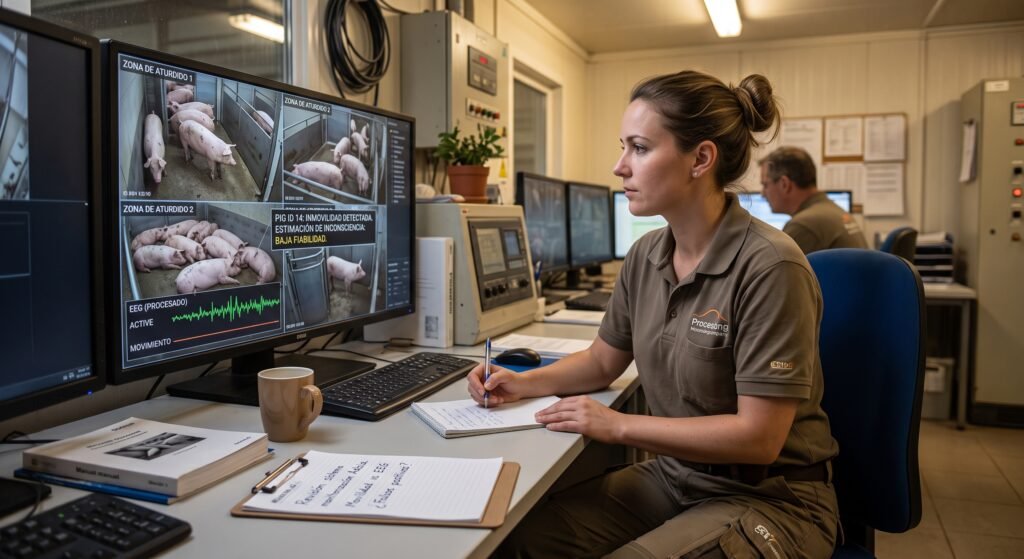
Assessing a stunning system requires a clear understanding of what its measurements can establish. For anyone developing, evaluating or adopting animal-welfare technology, that distinction should shape the questions asked before a trial begins.
What are we trying to establish?
Stunning aims to render an animal unconscious and insensible. Depending on the method, that state may be reversible. The assessment therefore needs to consider whether stunning is effective and whether unconsciousness is maintained until death.
EFSA describes monitoring throughout the interval between stunning and death. It also emphasises that indicators depend on the species and the stage of the process. An observation needs to be interpreted in that context. EFSA: animal welfare at slaughter.
For a technology assessment, this creates an important distinction between recording a visible event and establishing what that event means for the animal.
A useful finding from CO₂ research
In a 2016 experiment, Verhoeven and colleagues reported average EEG-based times to unconsciousness of 47 seconds with 80% CO₂ and 33 seconds with 95% CO₂, measured from the start of the gondola’s descent.
These were experimental findings, not universal commercial timings. The authors identified earlier entry into a high-CO₂ atmosphere as important to the difference. Their behavioural findings offered little basis for concluding that the treatments differed greatly in welfare impact.
Loss of posture could also occur before EEG-based unconsciousness. Posture alone therefore could not establish its exact onset. Verhoeven et al., 2016.
The period before unconsciousness matters
A welfare assessment also needs to examine the animal’s experience while consciousness remains.
EFSA’s assessment of pig slaughter identifies pain, fear and respiratory distress among the relevant welfare consequences. It considers hazards across arrival, handling, stunning and bleeding, linking them to animal-based measures and possible preventive or corrective actions.
That wider perspective matters when assessing a proposed improvement. Evidence about one part of the process does not establish the welfare performance of the entire system. Equipment, facilities, staff skills and management all feature in EFSA’s analysis. EFSA: Welfare of pigs at slaughter, 2020.
Questions worth asking a technology developer
At Aelzia, we propose beginning a technical discussion with a clearly defined claim. “Improves animal welfare” is an ambition; an assessment needs something more specific.
What outcome is intended to change?
Describe the experience or risk being addressed, the animals involved and the point in the process where improvement is expected.
What does the system actually measure?
A device may record movement, posture or another observable signal. Ask what evidence connects that measurement to the claimed welfare outcome, and under which conditions the interpretation is reliable.
What was the comparison?
Identify the existing practice or alternative against which the intervention was assessed. Request the study design, the number of animals and sites, and the conditions under which the results were obtained.
What remains uncertain?
Ask about missed events, false alerts, animals outside the tested range and situations where the equipment or interpretation may fail. Uncertainty should be recorded alongside favourable results.
What happens when a problem is detected?
Identify who receives the information, what action they can take and how the response will be evaluated. This is part of the proposed intervention, so it belongs in the assessment from the beginning.
These questions are Aelzia’s proposed starting point for evaluating an opportunity. They do not constitute a validated monitoring protocol.
From an interesting result to an adoption decision
A useful assessment should leave the reader able to distinguish the measured result, the interpretation placed on it and the decision it can reasonably support.
For Aelzia, an early discussion may lead to further evidence gathering, specialist review or preparation of a carefully defined trial. It may also show that a claim is too broad or that a technology is unsuitable for the proposed setting.
The next step should follow the evidence available. A product demonstration can begin the conversation; the adoption decision needs a documented account of what is expected to improve for the animals and how that improvement would be assessed.
Read more about Aelzia’s approach to assessing animal-welfare technology.
This article is an editorial synthesis of selected sources. It presents no original Aelzia trial results and has not undergone independent scientific peer review. It is intended to support informed discussion, rather than provide an operating protocol.